When the panel asks about A10 Thunder ADC, do not list features randomly. Draw the path, name the policy decision point, prove it with logs or health, then close with the fix and verification.
What you will learn in this interview page
- L1: explain why an ADC exists and how VIP, service group, server and monitor fit together.
- L2: trace one user request through L4-L7 load balancing, SSL/TLS offload, persistence and health checks.
- L3: troubleshoot a realistic outage without guessing: compare VIP state, member state, logs, server response and rollback evidence.
- Interview proof: answer with a flow, a failure hypothesis, a validation command or screen, and a clear production-safe fix.
Visual map: keep this image open while answering. The panel wants to hear the path, not a feature dump.
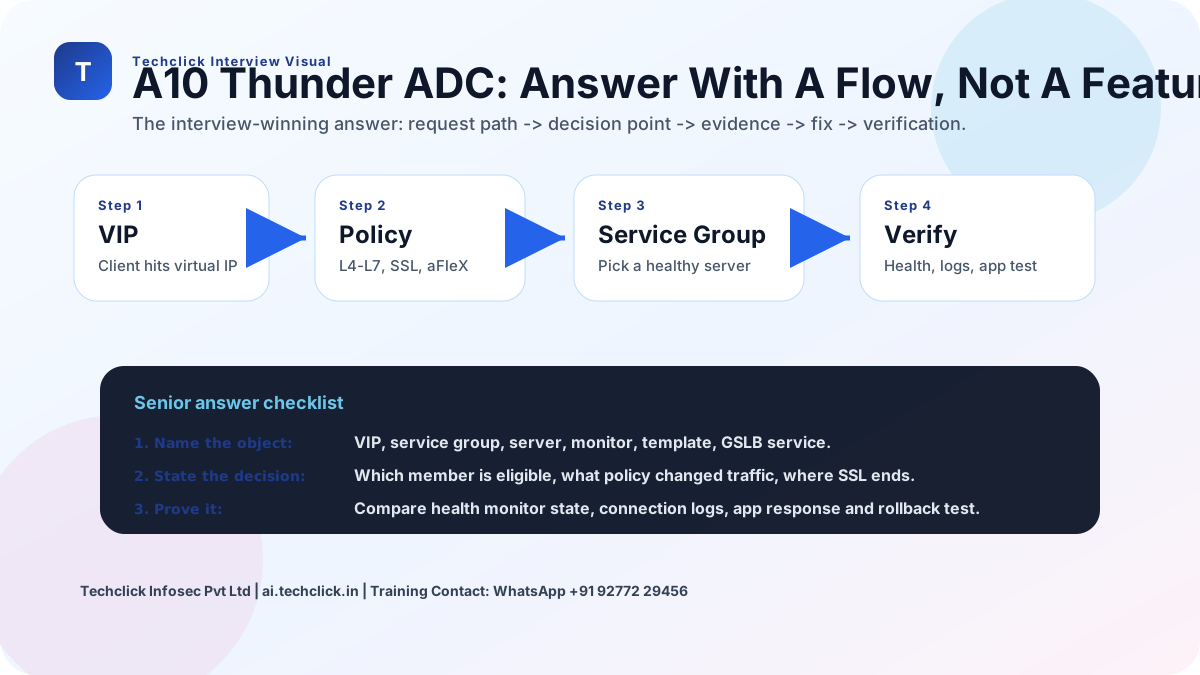
Infographic 1: normal request path
A user says the application is slow through A10. What is the first interview-safe framing?
Fundamentals and interview framing (5)
Define the platform, scope and mental model clearly.
L11. What is A10 Thunder ADC and what problem does it solve?
What is A10 Thunder ADC and what problem does it solve?
- 20 A10 Thunder ADC interview questions with model answers covering VIPs, pools, monitors, SSL offload, aFleX, WAF/DDoS and GSLB.
- Start with the business problem, then name the control path.
- A10 is an ADC in front of applications
- Virtual services map clients to pools
Interview tip: Keep the answer ordered: flow, evidence, fix, verify.
L12. Which components of A10 Thunder ADC should you name first?
Which components of A10 Thunder ADC should you name first?
- Name the objects before features.
- Virtual service/VIP
- Pool members
- Health monitor
- SSL profile
- GSLB service
Interview tip: Keep the answer ordered: flow, evidence, fix, verify.
L23. How is A10 Thunder ADC different from a point tool?
How is A10 Thunder ADC different from a point tool?
- A point tool solves one slice; this answer needs architecture, flow, policy and evidence.
- A10 is an ADC in front of applications
- Virtual services map clients to pools
- Health checks decide usable members
- GSLB steers users across sites
Interview tip: Keep the answer ordered: flow, evidence, fix, verify.
L24. What is the 30-second whiteboard answer?
What is the 30-second whiteboard answer?
- Draw: Virtual service/VIP -> Pool members -> Health monitor -> SSL profile.
- Add where logs/events are produced.
- End with the user/app verification step.
Interview tip: Keep the answer ordered: flow, evidence, fix, verify.
L35. What is the answer that sounds senior?
What is the answer that sounds senior?
- A senior answer is ordered and evidence-backed.
- I would say: Validate monitor depth, pool status, persistence, SNAT/SSL profile behavior and server logs.
- Then I would verify with logs plus the original business test.
Interview tip: Keep the answer ordered: flow, evidence, fix, verify.
Architecture, components and flow (5)
Name objects and trace one request, device or event end to end.
Infographic 2: object model and evidence map
A VIP is up, but users still fail. Which evidence best proves the next stage?
L26. Walk me through the normal traffic or telemetry path.
Walk me through the normal traffic or telemetry path.
- Use this ordered path: Virtual service/VIP -> Pool members -> Health monitor -> SSL profile -> GSLB service.
- At each hop, say what is decided and what evidence is produced.
Interview tip: Keep the answer ordered: flow, evidence, fix, verify.
L27. Where does policy apply?
Where does policy apply?
- Policy applies at the control point that can see enough context.
- A10 is an ADC in front of applications
- Virtual services map clients to pools
- Health checks decide usable members
- The answer must include logs, not just configuration.
Interview tip: Keep the answer ordered: flow, evidence, fix, verify.
L28. What logs or dashboards would you check first?
What logs or dashboards would you check first?
- Check the policy hit, object health, affected user/device/app, and final action.
- Then compare a working user against a failing user.
Interview tip: Keep the answer ordered: flow, evidence, fix, verify.
L39. What would you validate before production rollout?
What would you validate before production rollout?
- Forwarding/steering path
- Identity or device grouping
- Health checks or agent state
- Logging fields and rollback plan
Interview tip: Keep the answer ordered: flow, evidence, fix, verify.
L310. How would you integrate it with the rest of the security stack?
How would you integrate it with the rest of the security stack?
- Send logs to SIEM/SOC workflow
- Align identity groups and asset context
- Use firewall/NAC/EDR/SASE integrations where relevant
Interview tip: Keep the answer ordered: flow, evidence, fix, verify.
Policy, rollout and operations (5)
Explain how rules are scoped, piloted and measured.
Infographic 3: controls that change traffic
A release works for some users but not others. Which A10 control should be checked early?
L211. How do you avoid false positives or overblocking?
How do you avoid false positives or overblocking?
- Pilot first, monitor, tune scope, then enforce.
- Use narrow groups and known test cases before broad rollout.
Interview tip: Keep the answer ordered: flow, evidence, fix, verify.
L212. How do identity, device or app context affect the decision?
How do identity, device or app context affect the decision?
- They scope the rule so not every user gets the same treatment.
- The best answer names group/user/device/app context plus the final action.
Interview tip: Keep the answer ordered: flow, evidence, fix, verify.
L313. What is a strong change-control plan?
What is a strong change-control plan?
- Define pilot scope
- Capture baseline logs
- Enable one control at a time
- Document rollback and success tests
Interview tip: Keep the answer ordered: flow, evidence, fix, verify.
L314. What is the common design mistake?
What is the common design mistake?
- A VIP is up but traffic reaches a backend that is not truly healthy.
- The fix is not random tuning; trace the exact stage where evidence stops.
Interview tip: Keep the answer ordered: flow, evidence, fix, verify.
L215. Which metric tells you rollout is healthy?
Which metric tells you rollout is healthy?
- Low false positives
- Expected policy-hit volume
- Object/agent/health status green
- User-impact tickets declining
Interview tip: Keep the answer ordered: flow, evidence, fix, verify.
Troubleshooting and L3 scenarios (5)
Show the evidence-backed RCA sequence interviewers expect.
Infographic 4: L3 troubleshooting ladder
Which answer sounds most senior for "A VIP is up but the app is still failing"?
L216. A user says 'A10 Thunder ADC is blocking me'. What do you do?
A user says 'A10 Thunder ADC is blocking me'. What do you do?
- Confirm scope and symptom
- Trace the flow
- Check logs/events and health
- Validate monitor depth, pool status, persistence, SNAT/SSL profile behavior and server logs.
Interview tip: Keep the answer ordered: flow, evidence, fix, verify.
L217. What is your first RCA hypothesis for this page?
What is your first RCA hypothesis for this page?
- A VIP is up but traffic reaches a backend that is not truly healthy.
- Validate it with logs and a controlled retest.
Interview tip: Keep the answer ordered: flow, evidence, fix, verify.
L318. How do you prove the fix worked?
How do you prove the fix worked?
- Repeat the original user/app test
- Capture the new policy hit or health state
- Confirm no broader regression in logs/metrics
Interview tip: Keep the answer ordered: flow, evidence, fix, verify.
L319. Give a crisp L3 interview answer.
Give a crisp L3 interview answer.
- For A10 Thunder ADC, I trace components in order, validate policy/health/logs, fix the failed stage, then prove it with the original test.
- Validate monitor depth, pool status, persistence, SNAT/SSL profile behavior and server logs.
Interview tip: Keep the answer ordered: flow, evidence, fix, verify.
L120. What should a junior engineer never do first?
What should a junior engineer never do first?
- Do not change random production policy first.
- Collect scope, timestamp, user/device/app, rule hit and health state.
Interview tip: Keep the answer ordered: flow, evidence, fix, verify.
20-minute drill: Answer five questions out loud: what it is, core components, policy flow, common failure, and the L3 fix for A VIP is up but traffic reaches a backend that is not truly healthy..
Trap 1: "VIP is up, so ADC is fine." Wrong. VIP up is only the listener. You still need service group, member health and app response.
Trap 2: "Health monitor is green, so app is healthy." Maybe. A TCP monitor can pass while login, API or database dependency fails. Senior engineers ask what the monitor actually tests.
Trap 3: "GSLB is just DNS." Too shallow. In an interview, explain that GSLB uses site health and policy to steer users before they ever reach the local ADC.
Trap 4: "aFleX is only scripting." Better answer: aFleX can implement custom traffic logic, so it must be reviewed when only one URI, header, host, method or user group fails.
Wrap-up assessment - prove you can answer like an engineer
You already answered four inline checks. Submit all ten answers to mark this blog complete locally and practice the exact reasoning an interviewer expects.
Which object normally represents the front-door address users connect to?
A TCP monitor is green, but checkout still fails. What should you say?
Only one URL path is failing after an ADC change. What should be reviewed early?
What is the strongest GSLB interview answer?
A change fixed the test user but might affect production. What is the right closing statement?
You need a 30-second final answer. Which structure is best?
Official references used for this upgrade
- A10 Networks Thunder ADC product page - L4-L7 application delivery, high availability and application security positioning.
- A10 Thunder ADC data sheet - platform capability reference for ADC, SSL/TLS, GSLB, security and analytics language.
- A10 aFleX ADC solution brief - custom traffic-control and L7 policy scripting context.
- A10 official documentation portal - source for ACOS configuration and object-level operating references.